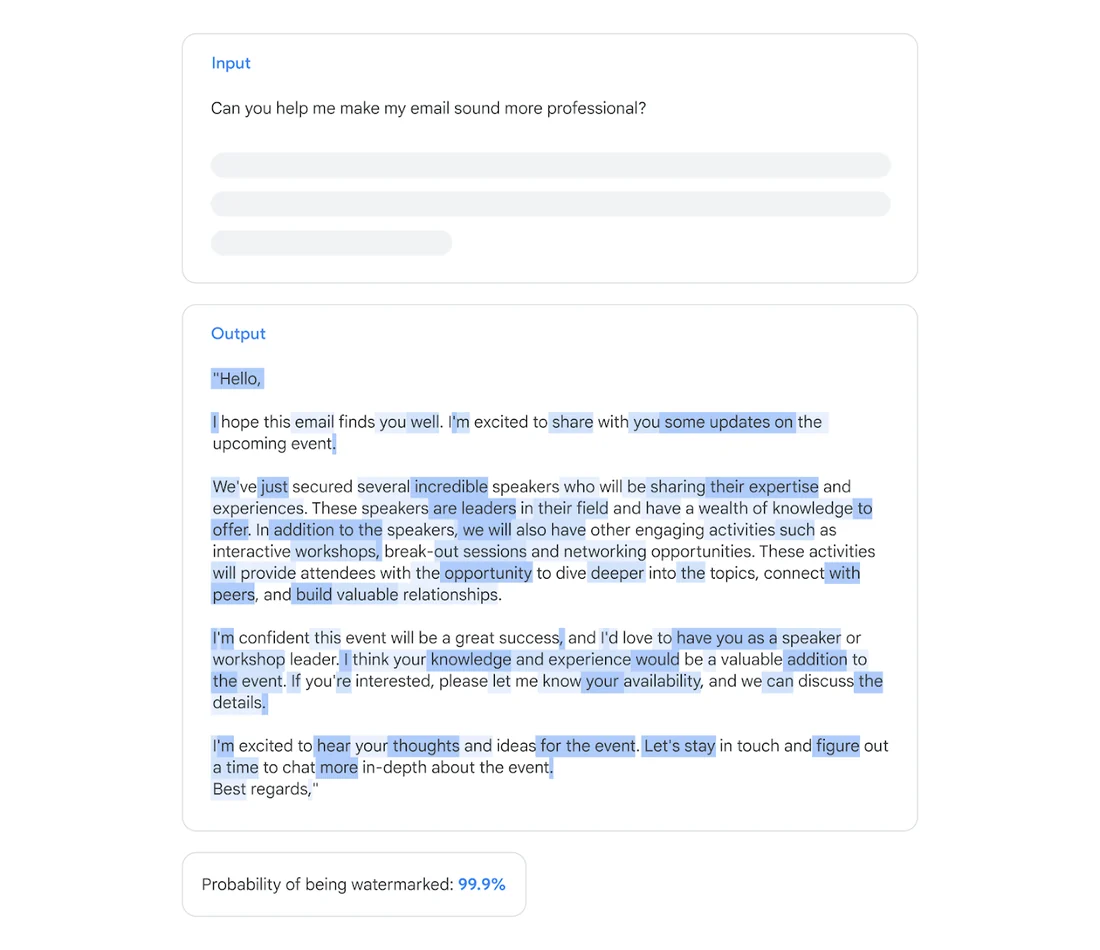
The system
SynthID is Google DeepMind's watermarking toolkit for AI-generated media, launched for images in 2023 and described today as embedding watermarks imperceptible to people but detectable by DeepMind's own tools, across images, video, audio and text, per the company's current SynthID overview. In May 2024 DeepMind announced two further capabilities, a text watermark and a video-frame watermark, in a company blog post that also said it planned to open-source the text method later that year.
What the documents establish
The technical basis followed five months later. In October 2024, DeepMind researchers published a peer-reviewed paper in Nature, Scalable watermarking for identifying large language model outputs, describing SynthID-Text: a scheme that adjusts only the token-sampling step of generation, leaves training untouched, and can be checked without the underlying model. The paper reports a live evaluation across nearly twenty million Gemini responses, testing whether the watermark held up in production, and states the method preserved text quality relative to unwatermarked output. Alongside the paper, DeepMind published a reference implementation on GitHub, google-deepmind/synthid-text, described in its own README as being for research reproducibility rather than production use, pointing production users toward a separate implementation in Hugging Face Transformers. None of these October 2024 documents describes an open-sourced watermark for audio. DeepMind's current SynthID page treats the audio watermark, used for content generated through Lyria and NotebookLM's podcast feature, as a separate component from the text scheme the Nature paper covers.
Craft and rights
For a producer, the distinction sets the limits of what a watermark check can tell you. DeepMind's blog post states the text watermark degrades under heavy rewriting or translation and performs worse on short, factual answers, and says plainly the technique is not built to stop a motivated adversary. The audio watermark is a different, unpublished method addressed by neither the paper nor the repository, so claims about one should not be read onto the other. The rights question here concerns disclosure, not licensing: a watermark supports a claim about how content was generated, but says nothing about whether the model's training data was licensed or consented to. Editorially, a rights holder relying on SynthID should treat an absent watermark as inconclusive, not proof of human origin.
Outcomes and open questions
The open-source release invites outside testing of detection accuracy beyond DeepMind's reported figures, and of how the scheme performs on models other than the Gemma and GPT-2 checkpoints used in the reference notebook. Whether a comparable watermark for AI-generated audio will be published, and how this work connects to standards such as C2PA, remains unresolved on the public record.
- Does the watermarking claim cover text, audio, image or video, and does that match what is being asserted?
- Would a negative watermark check demonstrate human authorship, or only the absence of one detectable signal?
- What does the vendor's documentation say about robustness to editing, rewriting or translation?
SynthID is best read as a detection aid layered on a larger provenance problem, and the October 2024 paper settles what it covers for text far more precisely than it settles anything about audio.
Sources & reading trail
DeepMind's own announcement of SynthID for text and video, its stated plan to open-source text watermarking, and its documented detection limits.
Source published: 14 May 2024 · Retrieved: 16 September 2026
Peer-reviewed technical description of SynthID-Text, its sampling-based method, and the reported 20-million-response Gemini evaluation.
Source published: 23 October 2024 · Retrieved: 16 September 2026
Reference implementation tied to the Nature paper; states it is for research reproducibility only and not production use.
Source published: Not established · Retrieved: 16 September 2026
Current living description showing audio watermarking (Lyria, NotebookLM) as a separate SynthID component from text watermarking.
Source published: Not established · Retrieved: 16 September 2026
Papers, reports and standards establish the entry; the craft-and-rights reading is Soundcraft AI editorial analysis. This retrospective draft does not imply the site published on the event date.