The system
The Coalition for Content Provenance and Authenticity (C2PA) is a standards body whose Content Credentials project page lists more than 500 member companies, including Adobe, Microsoft, Sony, Google, Meta, OpenAI, the BBC, Intel and Amazon. C2PA publishes an open technical specification for cryptographically signed content credentials, manifests that travel with a media file to record its origin and edit history. As retrieved on 16 September 2026, the current specification is version 2.3, dated December 2025.
What the documents establish
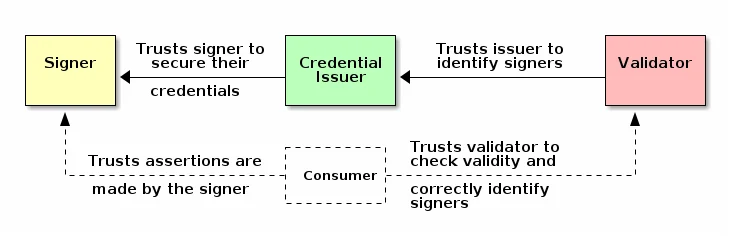
The specification defines format-specific rules for embedding a manifest in audio. For MP3 and FLAC files, the manifest store sits inside an ID3v2-compatible General Encapsulated Object; for WAV and Broadcast Wave Format files, it is embedded as the data of a RIFF chunk identified 'C2PA', required to appear as the last sub-chunk of the file's first RIFF header chunk; for .m4a downloadable audio, the ISO base media file format mechanism applies through a defined box type. Trust rests on validating the identity of the signer, whose private key cryptographically signs the claim, not on any property of the sound itself. The Content Credentials page adds that the project explicitly names 'photos, videos, audio files, and documents' as content types now producible convincingly enough to need this kind of verification.
Craft and rights
This gives a musician or rights holder a format-defined way to attach a verifiable record of who signed a file and what tools touched it, useful for disclosing AI involvement or asserting provenance at the file level, separate from any copyright claim. But the specification's own security model says plainly that a stripped manifest breaks the chain: removing an MP3's ID3 block or a WAV's RIFF chunk removes the credential with it, leaving nothing to validate. Because several of C2PA's own steering members build the AI generation tools whose output this standard is meant to flag, a credential discloses what a signer claims about a file's origin; it does not independently audit whether that claim is true.
Outcomes and open questions
Whether the roughly 500 member companies actually ship C2PA-compliant manifests in consumer DAWs, upload tools or music generators, versus image and video pipelines where adoption is further along, is not established by these two pages. The spec's own fallback for a stripped manifest, matching a watermark or fingerprint, is explicitly described as not statistically unique, so how much provenance survives once a track leaves its original file and format remains an open, practical question for music.
- Does the platform I am using actually preserve or check a C2PA manifest, or only accept the file regardless?
- What happens to a track's credential once it is converted, re-encoded or uploaded through a service that strips metadata?
- Is a given credential attesting to the file's origin, or only to a claim its signer chose to make?
C2PA's specification gives audio a defined, format-specific way to carry a signed provenance record, but the standard's own language is careful to describe that record as a trust signal tied to a signer's identity, not a tamper-proof guarantee once a file changes hands or format.
Sources & reading trail
The living specification's format-specific rules for embedding manifests in MP3, FLAC, WAV/BWF and M4A audio, and its signer-identity trust model.
Source published: Not established · Retrieved: 16 September 2026
C2PA's governance and member-company list, and the project's own framing of audio as a content type requiring provenance verification.
Source published: Not established · Retrieved: 16 September 2026
Papers, reports and standards establish the entry; the craft-and-rights reading is Soundcraft AI editorial analysis. This retrospective draft does not imply the site published on the event date.