The system
MusicVAE is a model from Google's Magenta research group for learning a compressed, navigable representation of musical scores, released alongside the browser and desktop tools that became Magenta Studio. Magenta's own project page describes it as "a hierarchical recurrent variational autoencoder for learning latent spaces for musical scores," working on symbolic, MIDI-like note sequences such as melodic fragments, drum loops and multi-instrument arrangements rather than on finished audio. A trained MusicVAE does not generate a waveform; it generates a sequence of notes that still needs a synthesizer, sampler or performer to become sound, which separates it from later systems that generate audio directly.
What the documents establish
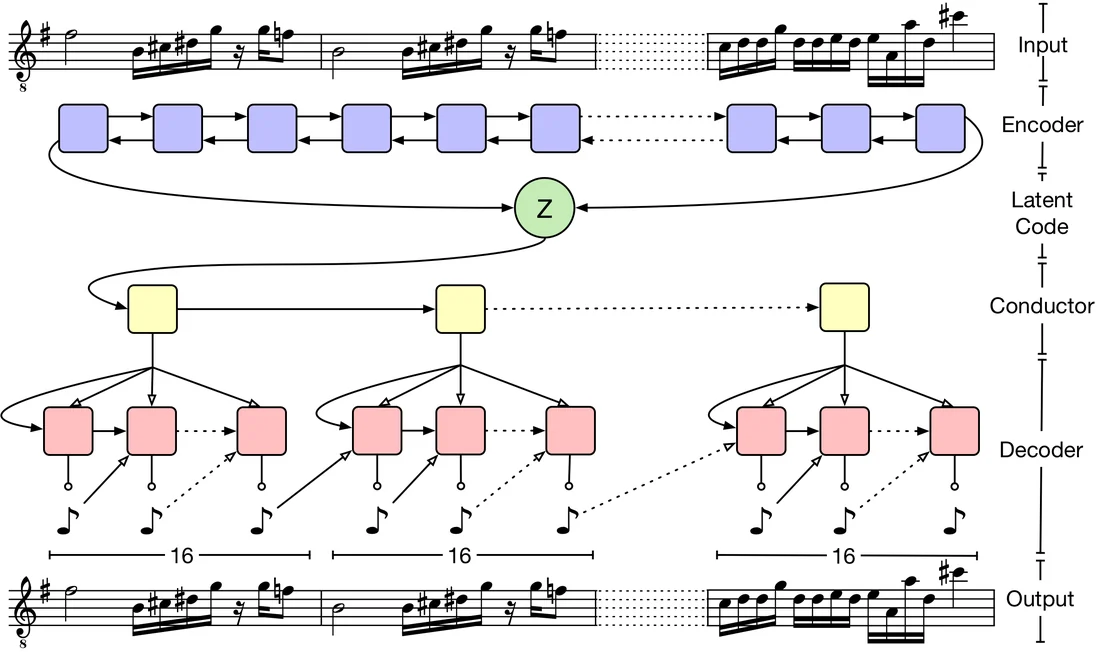
The underlying paper, posted to arXiv on 13 March 2018, introduces a hierarchical decoder that "first outputs embeddings for subsequences of the input and then uses these embeddings to generate each subsequence independently," a design built to address posterior collapse, a known failure mode where a recurrent variational autoencoder learns to ignore its own latent code. The paper reports that this hierarchical structure improves sampling, interpolation and reconstruction compared with a flat baseline model. Magenta's page adds the practical description: a "conductor" network generates one embedding per bar, which then conditions independent note decoders for each section of a longer piece, and the team released both a JavaScript library for in-browser inference and a TensorFlow implementation, rather than keeping the model as a research-only artifact.
Craft and rights
Because MusicVAE operates on note sequences rather than recorded audio, its most direct creative use is compositional: smoothly interpolating between two melodies, or adjusting an attribute such as note density while keeping a phrase's overall structure, functions closer to a sketching tool than to a finished-track generator. That keeps a human arranger, performer or producer responsible for the actual sound a listener hears, since the model's output is an editable score rather than a mixed and mastered file. Neither document specifies what corpus of scores trained the released checkpoints, which is a real limit on what can be claimed about the model's stylistic range or any resemblance to specific existing compositions.
Outcomes and open questions
MusicVAE's symbolic, editable output has aged differently from raw-audio generators: it remains easier to audit and to attribute a resulting composition to a specific human editing choice, precisely because the model's output stays one step removed from a finished recording.
- What training corpus of scores underlies a given released MusicVAE checkpoint?
- Does a workflow use MusicVAE for sketching structure, or for a note sequence shipped unedited?
- How does a symbolic model's editability change the authorship question compared with raw-audio generation?
MusicVAE is a reminder that "AI-generated music" spans very different outputs, from an editable MIDI sketch to a finished waveform, with correspondingly different craft and rights consequences for the person using it.
Sources & reading trail
Introduces the hierarchical decoder built to address posterior collapse and reports gains in sampling, interpolation and reconstruction.
Source published: 13 March 2018 · Retrieved: 16 September 2026
Describes the conductor-RNN structure, browser and TensorFlow releases, and interpolation and attribute-vector capabilities.
Source published: 15 March 2018 · Retrieved: 16 September 2026
Papers, reports and standards establish the entry; the craft-and-rights reading is Soundcraft AI editorial analysis. This retrospective draft does not imply the site published on the event date.