The system
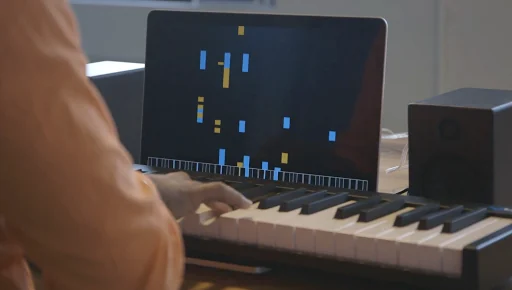
A.I. Duet is a browser experiment built by Google Creative Lab's Yotam Mann with Google's Magenta research team, letting a visitor play a few notes on an on-screen keyboard, a laptop keyboard or a connected MIDI device and hear a neural network answer with its own musical phrase. The experiment's own page describes it as "a piano that responds to you," built with TensorFlow, Tone.js and Magenta's open-source tools, and pitched at people who do not play an instrument: "you don't even have to know how to play piano." Unlike a fixed demo reel, every session is generated live from whatever the visitor plays, so the output is not a pre-rendered sample but a real-time response from a trained model.
What the documents establish
Both Magenta's own account, "Learning from A.I. Duet", and Google's official announcement, credited to Creative Lab coder and musician Alexander Chen, are dated 16 February 2017 and describe the release as new at the time, crediting Magenta, which the Google post says had launched "the previous year." That places the public web release later than the "2016" shorthand this topic is often filed under, though a Magenta demo combining several of the same underlying models had already won "Best Demo" at the NIPS conference in December 2016. The Magenta post is candid about limits: the models are "not designed to flexibly accommodate tempo changes" and are "not responsive to expressive timing," so notes are sometimes dropped or misjudged in length, and the wait-time setting for when the system judges a phrase finished materially affects how natural an exchange feels.
Craft and rights
Because A.I. Duet responds only to notes played live in the browser session, it generates no persistent recording tied to any external performer's copyrighted material, and Magenta released the underlying code as open source, inviting exactly the kind of hacking on the model that its own follow-up post documents. The more durable craft point is about capability versus result: the tool demonstrates real-time responsiveness to a human player, which is a narrower and more constrained thing than an automated composition tool, and Magenta's own list of timing limits shows the developers were explicit that the system's grasp of musical phrasing remained partial rather than presenting the demo as a finished instrument.
Outcomes and open questions
A.I. Duet's most durable legacy is procedural rather than musical: it showed that a generative model could be wrapped in a browser interface simple enough for a non-musician to try in seconds, a template later reused across Google's other Experiments with Google releases.
- Is a given "2016" AI-music milestone dated to a private demo or to public release?
- What specific timing or tempo limits does a real-time generative tool disclose about itself?
- Does an open-source release let independent researchers verify a vendor's stated limitations?
Read next to its own documentation, A.I. Duet reads less as a finished creative tool than as a public, hackable test of how a Magenta model handles live, unrehearsed human input.
Sources & reading trail
The experiment's own page credits Google Creative Lab and Magenta, and describes the keyboard and MIDI interaction.
Source published: Not established · Retrieved: 16 September 2026
Confirms the release date and documents specific tempo and timing limits of the underlying Magenta models.
Source published: 16 February 2017 · Retrieved: 16 September 2026
Google's own announcement names Creative Lab's Alexander Chen as builder and frames the tool's accessibility.
Source published: 16 February 2017 · Retrieved: 16 September 2026
Papers, reports and standards establish the entry; the craft-and-rights reading is Soundcraft AI editorial analysis. This retrospective draft does not imply the site published on the event date.