
The system
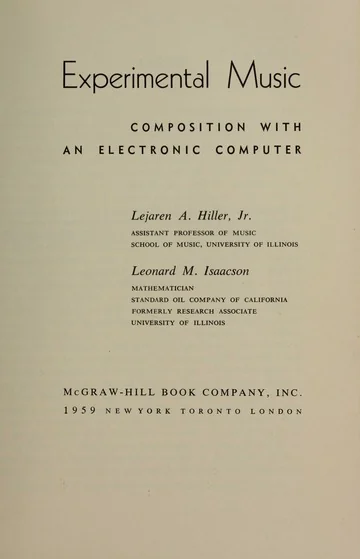
The Illiac Suite is a four-movement string quartet whose pitches and rhythms were generated with the help of the ILLIAC I computer at the University of Illinois. Lejaren Hiller, a chemist turned composer, and Leonard Isaacson built it, and documented it in their own 1959 book, Experimental Music: Composition with an Electronic Computer. The book is a first-person research record: it treats each of the piece's four movements, called Experiments, as a test of whether a machine could be made to follow, and depart from, rules of tonal part-writing.
What the documents establish
Hiller and Isaacson began work in September 1955, coding the ILLIAC to generate simple cantus firmi. By July 1956 the first three movements, minus a coda, existed, and on 9 August 1956 they were performed publicly at the University of Illinois in Urbana. The book names the players: Robert Swenson, cellist with the Walden String Quartet then in residence at the university, joined by three graduate students, Sanford Reuning, Peggy Andrix and George Andrix. Only the cellist belonged to the resident Walden quartet. The coda and fourth movement followed by November 1956, and the complete score appeared in New Music Edition the next year. A later rule-based re-analysis of the score confirms the method the book describes: screening rules that accepted or rejected randomly produced pitches, with probability tables governing melodic intervals in the fourth movement that shifted every two measures, moving from sustained unisons toward the full chromatic vocabulary.
Craft and rights
Nothing here resembles a trained model absorbing a corpus. Hiller and Isaacson hand-coded rules from classical part-writing conventions, then let the machine's random-number generator propose candidates the rules could reject. Authorship sat in the design of that screening logic, not in any single note-level decision. That is an early, low-stakes version of a question this site returns to: when a system proposes material and a human curates it, credit follows whoever wrote the constraints, not whoever ran the search. New Music Edition published the score under Hiller and Isaacson's names alone, with no dispute recorded about where authorship belonged.
Outcomes and open questions
The detail that the piece was premiered by the Walden String Quartet is a compression the composers' own chronology does not support; only its cellist played that night. Hiller also mentions, without full explanation, that later probability tables depended on preceding choices, a refinement the account describes only in passing. Both gaps matter whenever a tidy origin story circulates about an early computer-music milestone.
- What does the primary account actually name as the performing ensemble, versus what later retellings assume?
- Where output was screened by hand-written rules rather than learned from examples, who is doing the composing?
- What details of a documented method do even its own authors acknowledge as incomplete?
The Illiac Suite is often reduced to one fact, a computer wrote a string quartet, when the more useful record is a chronology of specific choices: which rules, which rejections, and which four musicians were actually in the room on 9 August 1956.
Sources & reading trail
Hiller and Isaacson's own 1959 chronology of the Illiac Suite's composition, the 9 August 1956 concert, and the named performers.
Source published: Not established · Retrieved: 16 September 2026
Academic re-analysis confirming the screening-rule and probability-table method behind the suite, with detail on the fourth movement.
Source published: Not established · Retrieved: 16 September 2026
Papers, reports and standards establish the entry; the craft-and-rights reading is Soundcraft AI editorial analysis. This retrospective draft does not imply the site published on the event date.