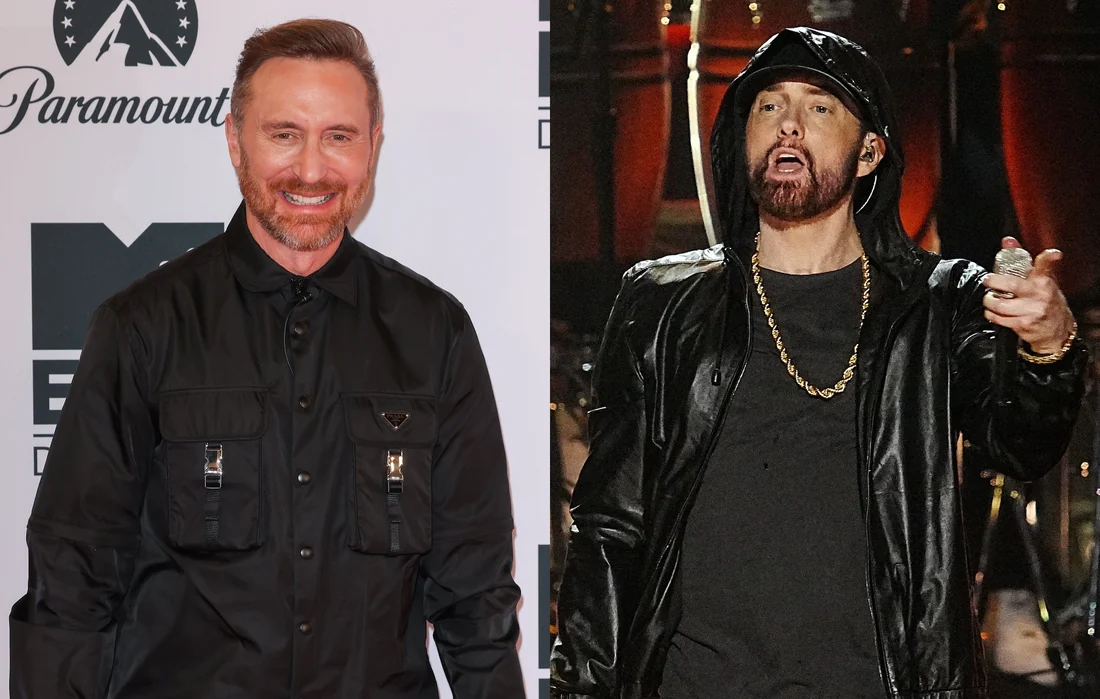
The system
In early February 2023, DJ and producer David Guetta played an unreleased track at a live set that used an AI-generated verse imitating Eminem's voice and delivery. He posted a video of the moment and then discussed the experiment in follow-up press interviews. This is a documented case of a commercially successful, working artist testing an unauthorised voice-style AI tool himself, in public, and explaining exactly how he built it rather than letting the clip stand unexplained.
What the documents establish
Guetta's own account, as quoted by NME, describes the process step by step: 'I discovered those websites about AI, basically, you can write lyrics in the style of any artist you like... So I typed, write a verse in the style of Eminem about future rave. And I went to another AI website that I can recreate the voice. I put the text in that and I played the record and people went nuts.' He captioned the original clip 'Let me introduce you to... Emin-AI-em' and stated directly, 'obviously I won't release this commercially.' A second report, covering a BBC interview Guetta gave at the BRIT Awards, quotes him saying 'I'm sure the future of music is in AI... But as a tool,' comparing it to earlier technologies: 'There would be no rock 'n' roll if there was no electric guitar... no hip-hop without the sampler.' Independent BBC reporting from May 2023 references the same clip as an established example, describing it plainly as an instance where Guetta 'used the technology... to add Eminem's voice for one of his tracks.'
Craft and rights
Guetta's own framing separates the demonstration from a commercial release: none of the sources describe Eminem, or any representative of his catalog, as having authorised the voice or lyric style, and Guetta repeatedly states the track will not be released. That distinction, a private joke made public versus a released, monetised product, does real rights work: an unreleased, non-commercial demo raises a narrower question than a streamed single would. Guetta's comparison of AI to the sampler and the electric guitar is his own framing of the technology as an instrument rather than a substitute for a performer; none of the cited sources record any response from Eminem himself.
Outcomes and open questions
What remains undocumented is whether Guetta or any collaborator sought consent from Eminem or his rights holders at any point, or whether the underlying voice model was trained on his commercially released recordings.
- Did Eminem or his representatives ever respond publicly to the clip, and has any authorised version followed?
- Has Guetta released any AI-assisted track since under a different, consented arrangement?
- How would this experiment be treated differently under an artist-approval model like Kits AI's, covered elsewhere in this archive?
The clearest fact these sources support is that Guetta built and demonstrated the clone himself, said so on the record, and chose not to release it, a materially different case from an anonymously distributed deepfake.
Sources & reading trail
First report quoting Guetta's own explanation of how he generated the AI Eminem-style verse and his statement that he would not release it commercially.
Source published: 8 February 2023 · Retrieved: 16 September 2026
Follow-up report quoting Guetta's BBC interview at the BRIT Awards, framing AI as a tool comparable to earlier musical technologies.
Source published: 14 February 2023 · Retrieved: 16 September 2026
Independent BBC confirmation that Guetta used the technology to add an Eminem-style voice to a track, cited months later as a reference case.
Source published: 18 May 2023 · Retrieved: 16 September 2026
Papers, reports and standards establish the entry; the craft-and-rights reading is Soundcraft AI editorial analysis. This retrospective draft does not imply the site published on the event date.