The system
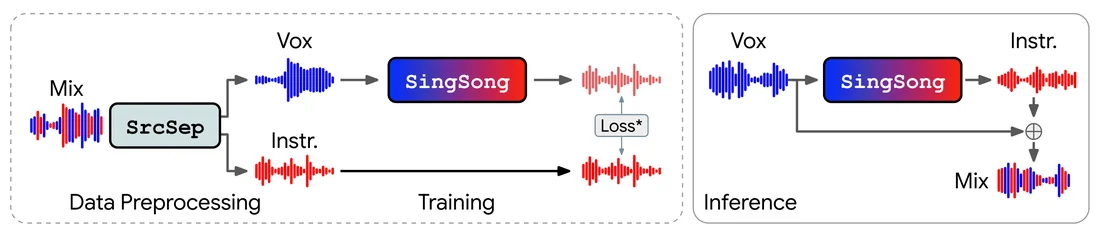
SingSong is a Google Research system, described in a paper submitted 30 January 2023, that generates instrumental accompaniment for an input vocal track. Rather than composing from a text prompt, it takes a person's singing as the conditioning signal and produces backing instrumentation intended to fit it, adapting AudioLM's token-based approach to an audio-to-audio task. The paper and its project page present SingSong as a research system with published sound examples, not a shipped consumer application.
What the documents establish
The paper states its training pairs are manufactured rather than collected as vocal-instrumental pairs directly: the authors apply the MDXNet source-separation algorithm to roughly one million existing tracks, totalling 46,000 hours of music, splitting each into a vocal stem and an instrumental stem and training the model to predict the instrumental from the vocal. The paper does not name the source or licensing status of that million-track corpus beyond calling it a large, diverse corpus of music audio. For evaluation, the authors use the MUSDB18 dataset, 10 hours of professional, studio-isolated stems, computing Fréchet Audio Distance against a retrieval baseline that pulls an existing instrumental track rather than generating one. In a pairwise listening test, the paper reports listeners expressed a significant preference for SingSong's generated instrumentals over that retrieval baseline.
Craft and rights
SingSong's premise — sing into a system and receive a backing track — sits close to the promise many amateur and professional vocalists want from AI tools, and the paper frames this as a way to let non-musicians participate in composition. The unresolved question the paper leaves open is what happens to the copyright of the original recordings used to build the training pairs: source-separating a track does not change who owns the composition or the master, and the paper's silence on the corpus's licensing status means a reader cannot verify whether the underlying million tracks were cleared for this use. This is an editorial read of a gap in the paper, not a claim that the training was or was not lawful.
Outcomes and open questions
The paper acknowledges its own accompaniments can carry faint source-separation artifacts left over from the training pairs, and it flags a generalisation gap between performance on isolated studio vocals versus noisier, separated ones. Because SingSong was never released as a public tool, later systems building on the same vocal-to-accompaniment idea are the only way to see whether that gap, or the training-data disclosure gap, narrows.
- If a dataset is built from source-separated commercial recordings, who cleared that use, and is it stated anywhere?
- Does a reported preference test compare against a strong enough baseline to be meaningful for your own use case?
- What audible artifacts might a generated accompaniment inherit from the separation process that built its training data?
SingSong is a clear method paper about a specific idea — accompaniment from source-separated pairs — and its research framing should not be mistaken for a documented, licensed data pipeline.
Sources & reading trail
States the source-separation training method, the unnamed million-track/46,000-hour corpus, the MUSDB18 evaluation set, and the listener preference result.
Source published: 30 January 2023 · Retrieved: 16 September 2026
Confirms SingSong was presented with published sound examples as a research system, not a public product.
Source published: Not established · Retrieved: 16 September 2026
Papers, reports and standards establish the entry; the craft-and-rights reading is Soundcraft AI editorial analysis. This retrospective draft does not imply the site published on the event date.