The system
The system studied is a semester-long teaching design, not a single app: Ziqiu Zhuang and Xue Li's study of generative-AI-supported collaborative music creation, published in Frontiers in Psychology and available as an open-access article (posted online 9 December 2025, formally dated 6 January 2026 by the journal). The full PDF names the tools used in class: Baidu's Wenxin Yi Yan for lyric assistance alongside a named AI music generation platform, MusicHero, for composition support.
What the documents establish
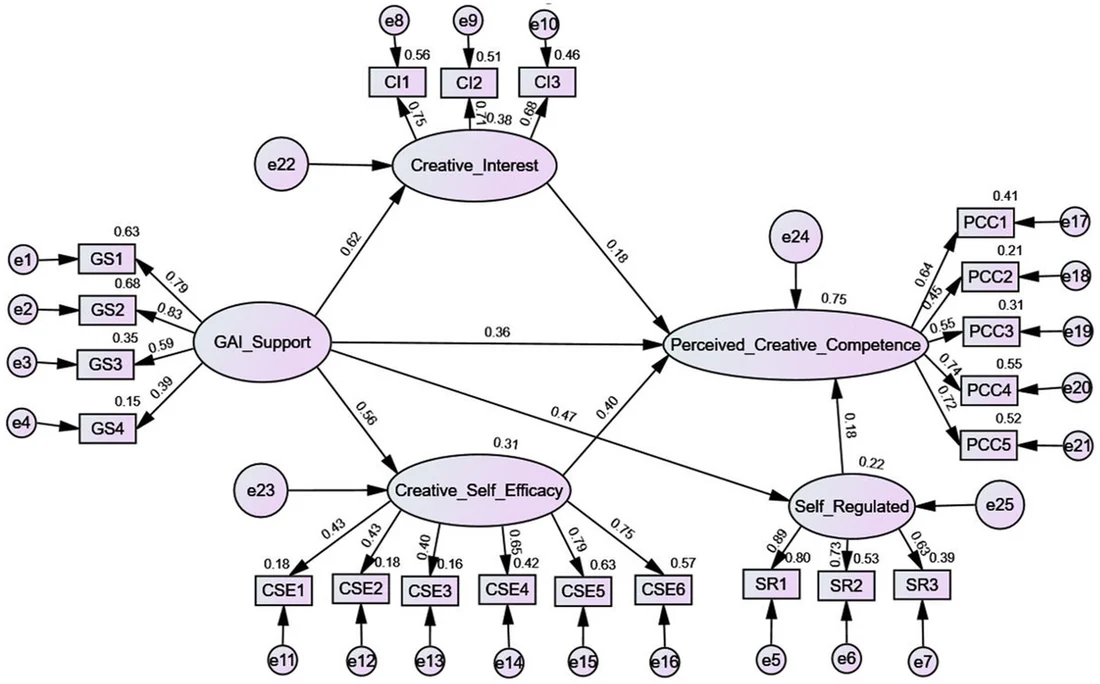
The sample was 405 university students in China, specifically music composition majors who had already completed coursework in the subject, not a general student population. Classes offering music composition were randomly assigned to a GAI-supported experimental group or a no-GAI control group across a structured course: a preparation week, weeks of composition theory, then a final module requiring each student to submit a complete original piece with lyrics and music. Using combined structural equation modeling and experimental comparison, the paper reports GAI support as a significant predictor of creative interest (standardized path coefficient 0.616), creative self-efficacy (0.557), self-regulated learning (0.473) and perceived creative competence (0.357), with the first three also predicting perceived creative competence in turn. The experimental group outperformed the control group on these measures.
Craft and rights
The population boundary matters more than the headline numbers: these are music-composition majors inside a graded course, using two named consumer tools under instructor supervision, not professional songwriters delivering commercial work. What the paper measures is self-reported interest, self-efficacy and self-regulated learning, not an outside listener's judgment of the resulting songs' quality. Extending this classroom result to a claim about professional songwriting or lasting musicianship goes beyond what the study tested. The paper is also silent on who holds rights in student compositions made partly with third-party generative tools during coursework, a gap any institution adopting this model would still need to resolve on its own, separate from what this research establishes.
Outcomes and open questions
The sample is drawn from a single country and a methods section that describes it as a convenience sample at one university, which limits how far the numbers travel. Every outcome is self-reported rather than judged by outside evaluators of the finished compositions, and the paper does not report whether gains in stated interest or self-efficacy persisted after the twelve-week course ended. Whether the same design would hold for non-major students, older learners, or a different pair of tools is untested here.
- Is this a study of professional songwriting outcomes, or of students' self-reported experience in a course?
- Who is expected to hold rights in coursework created with named third-party AI tools?
- Did the study measure how good the resulting music actually was, or only how students felt about making it?
Within a bounded classroom setting, the paper documents a measurable link between GAI-supported collaboration and several self-reported creativity outcomes among music majors, a result specific to that population and design rather than a general verdict on AI and songwriting.
Sources & reading trail
Authors, journal, publication dates and the headline structural-equation-modeling path coefficients from the abstract.
Source published: 9 December 2025 · Retrieved: 16 September 2026
Full methodology: the music-composition-major sample, randomized class assignment, twelve-week course structure and the two named tools (Wenxin Yi Yan and MusicHero) used by the experimental group.
Source published: 9 December 2025 · Retrieved: 16 September 2026
Papers, reports and standards establish the entry; the craft-and-rights reading is Soundcraft AI editorial analysis. This retrospective draft does not imply the site published on the event date.