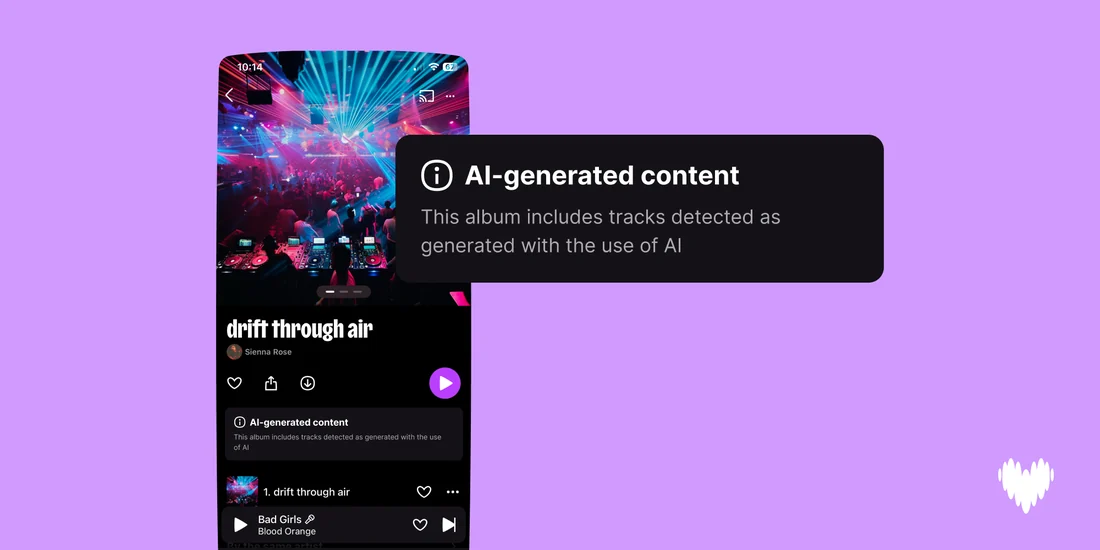
The system
Deezer is a music streaming platform that has run an in-house AI-detection tool since the start of 2025, tagging tracks it identifies as fully AI-generated and excluding them from algorithmic recommendations and editorial playlists. On 21 July 2026 its newsroom published a release stating that, for the first time, AI-generated tracks exceeded half of all daily new music uploads, peaking in June 2026. A separate June 2026 post describes a free consumer-facing tool, built on the same detection system, that lets listeners scan playlists across more than twenty platforms.
What the documents establish
The July release states Deezer was receiving close to 90,000 fully AI-generated tracks daily, over 50 percent of total daily deliveries at peak in June 2026, and that more than 13.4 million such tracks were detected and tagged across 2025. It states the detection tool's accuracy at 99.8 percent, missing roughly two in a thousand AI tracks and misflagging fewer than one in ten thousand genuine ones, according to Deezer's own reporting. Despite the upload volume, Deezer states fully AI-generated tracks account for only one to three percent of actual streams, because tagged tracks are excluded from recommendations; it also states up to 85 percent of streams on AI tracks were fraudulent. Following the milestone, Deezer says it will take down AI tracks used for streaming fraud and those unplayed for six months or more.
Craft and rights
For artists relying on royalty pools, the operative fact is not the upload count but the exclusion mechanism: Deezer's own account is that demonetising and delisting fraudulent AI uploads, rather than banning AI music outright, is what limits impact on legitimate payouts. This is Deezer's self-reported detection and enforcement outcome, not an independently audited figure, and the 99.8 percent accuracy claim comes from the same source describing its own system. The rights question here is one of platform governance rather than authorship: no human review confirms every one of the roughly 90,000 daily flagged tracks, so a detection error carries direct consequences for a real artist misclassified either way.
Outcomes and open questions
Deezer frames crossing the 50 percent threshold as a milestone justifying stricter takedown policy, but the underlying detection method, model version, and error-rate methodology are described only in the newsroom posts themselves, not in a published technical paper. Whether other major platforms report comparable upload shares, and whether Deezer's percentage continues climbing past the June 2026 peak, remain open. So does whether the demonetisation-based approach fully protects royalty pools as AI-generation tools keep improving.
- Does the platform state its detection method's accuracy and error rate, and is that figure independently verified or self-reported?
- What share of flagged uploads are demonetised for fraud specifically, versus simply excluded from recommendations?
- Has the reported upload percentage been updated since the cited post, and does the newer figure move up or down?
Deezer's own dated figures are the clearest public data point on AI-upload volume from a major streaming service, but they describe one platform's detection system and enforcement choices, not an industry-wide measurement.
Sources & reading trail
States Deezer's own upload-share, detection-accuracy and stream-share figures, and that AI uploads exceeded 50% of daily deliveries for the first time at peak in June 2026.
Source published: 21 July 2026 · Retrieved: 16 September 2026
Describes the consumer-facing detector tool built on Deezer's detection system and confirms the detection system's operation.
Source published: 11 June 2026 · Retrieved: 16 September 2026
Papers, reports and standards establish the entry; the craft-and-rights reading is Soundcraft AI editorial analysis. This retrospective draft does not imply the site published on the event date.