
The system
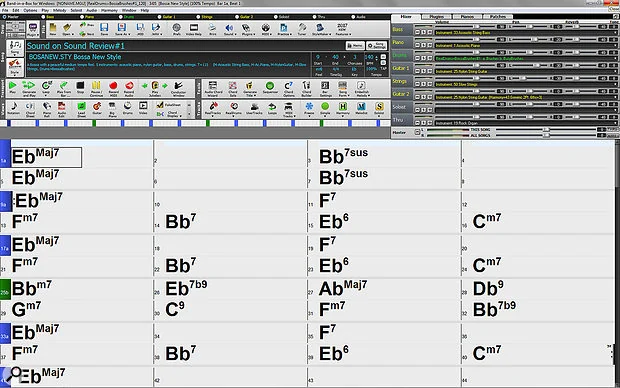
Band-in-a-Box is auto-accompaniment software from PG Music that generates a full backing arrangement from a typed chord chart. PG Music's own company history page states the company 'was founded in 1988 by program creator Dr. Peter Gannon' and that Band-in-a-Box was 'a finalist in the prestigious PC Magazine "Award for Technical Excellence" in 1990,' the recognition that marks the product's early public arrival.
What the documents establish
Gannon's own description of the original product, quoted in a Canadian Music Trade profile PG Music hosts on its own site, is unambiguous about what the first version generated: 'We started out with Band-in-a-Box as a MIDI program, generating MIDI and synth accompaniments.' A 2017 Sound On Sound review corroborates the date independently, with the reviewer writing 'I first used BIAB in 1990,' and traces the product's evolution 'from a relatively simple program with only MIDI output, to an impressive collection of both MIDI and audio tools,' naming RealDrums as a 2006 addition and RealTracks, built from recordings of live musicians rather than synthesised patterns, as arriving in 2007.
Craft and rights
The shift documented here, from generated MIDI patterns to licensed recordings of real players, is itself a rights story: RealTracks and RealDrums are described by both sources as actual performances by session musicians, meaning the backing tracks a user hears are built from cleared human recordings rather than synthetic patterns alone. That is a materially different arrangement from a system trained on scraped audio, and it predates by nearly two decades the current debate over whether a generative audio model's training data was licensed. For a working musician, the practical craft question a chord-chart generator like this raises has stayed consistent for over thirty years: how much of a finished arrangement's character comes from the chart typed in, and how much from the pre-built instrumental material behind it.
Outcomes and open questions
The specific claim that the original 1990 release shipped for the Atari ST alongside PC is widely repeated but was not independently confirmed in the company and press pages read for this entry; a reader who needs that detail sourced precisely should check contemporaneous 1990 computer-magazine coverage rather than later retrospectives.
- Does a described feature belong to the original MIDI-only product or to a later audio-based version such as RealTracks?
- When a backing-track library is built from recorded musicians rather than synthesis, what does that change about clearance and credit?
- How much of what a chord-chart generator produces is attributable to the user's input versus the shipped instrumental library?
Three decades on, Band-in-a-Box's own history is a useful baseline for how a generative music tool can shift its underlying method, from rule-based MIDI patterns to licensed human recordings, without changing what the user actually types into it.
Sources & reading trail
Company's own founding date (1988) and the 1990 PC Magazine Award for Technical Excellence recognition for Band-in-a-Box.
Source published: Not established · Retrieved: 16 September 2026
Direct quote from founder Peter Gannon describing the original product as a MIDI-and-synth-only accompaniment generator.
Source published: Not established · Retrieved: 16 September 2026
Independent reviewer confirmation of first use in 1990 and dates for the RealDrums (2006) and RealTracks (2007) recorded-audio additions.
Source published: Not established · Retrieved: 16 September 2026
Papers, reports and standards establish the entry; the craft-and-rights reading is Soundcraft AI editorial analysis. This retrospective draft does not imply the site published on the event date.